Gold demand rises as central banks accelerate reserve diversification amid currency uncertainty
MarketAlleys Desk
Published · 2 min read
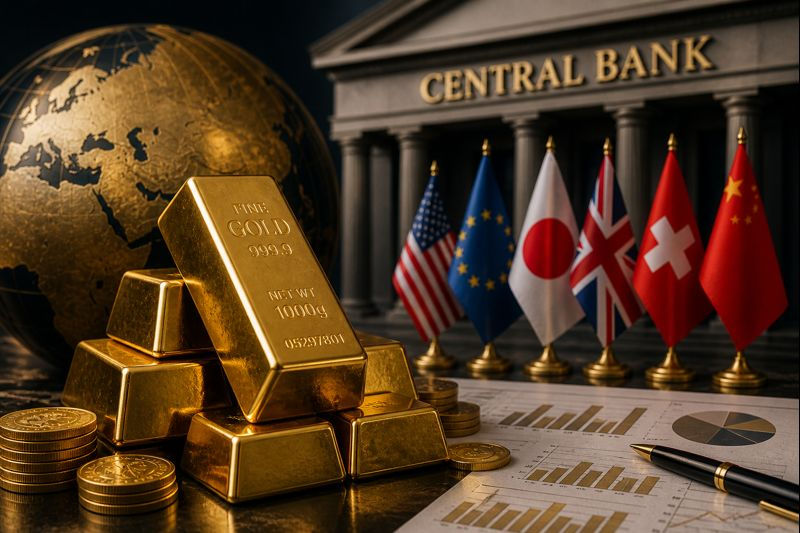
Gold is attracting renewed attention in global markets as central banks increase their purchases in response to growing uncertainty around major currencies. This shift reflects a broader effort to diversify reserves and reduce reliance on traditional financial systems, particularly in an environment shaped by geopolitical tension and shifting monetary dynamics.
One of the main drivers behind this trend is the evolving perception of currency risk. As global economic conditions remain uneven and policy paths diverge across major economies, confidence in long term currency stability is being reassessed. Central banks are responding by increasing exposure to assets that are perceived as more stable and less dependent on the policies of any single country.
Gold’s role as a reserve asset is central to this strategy. Unlike currencies, it is not tied to a specific government or monetary system, making it an attractive option during periods of uncertainty. This independence allows central banks to strengthen the resilience of their reserves while maintaining flexibility in managing external risks.
The pace of accumulation is also noteworthy. Central bank demand is becoming a more consistent and influential component of the gold market, providing a layer of structural support that goes beyond short term investor sentiment. This sustained buying activity is helping reinforce the metal’s position within the global financial system.
At the same time, broader market participants are taking note of this shift. Institutional investors and asset managers are increasingly aligning with central bank behavior, viewing gold as a strategic asset rather than a purely defensive one. This change in perception is contributing to stronger demand and increased attention across financial markets.
Currency volatility is further amplifying this trend. Fluctuations in exchange rates, particularly among major economies, are encouraging diversification as a means of managing exposure. Gold, with its historical role as a store of value, is benefiting directly from this environment.
Investor sentiment is gradually adapting to these developments. Rather than reacting solely to short term price movements, market participants are focusing on underlying structural changes. The growing role of central bank demand is seen as a key factor that could influence the direction of the gold market over a longer horizon.
Looking ahead, the trajectory of gold will depend on how global currency dynamics evolve. If uncertainty remains elevated and diversification efforts continue, demand for gold is likely to stay strong, reinforcing its importance as a core asset within the global financial landscape.
Terms in this article
Gold (XAU)
A precious metal held as a store of value, a hedge against currency debasement and a safe haven, as well as used in jewellery and industry.
Central bank
The institution that sets a country's or region's monetary policy, issues its currency and oversees the banking system — for example the Federal Reserve, European Central Bank, Bank of England and Bank of Japan.
Diversification
Spreading capital across assets whose prices do not move in lockstep, so that a loss in one holding has less effect on the whole portfolio.
Volatility
The size and speed of price changes, commonly measured as the annualised standard deviation of returns.
Exchange rate
The price of one currency in terms of another.
Ask about this story
Questions are answered only from this article and the sources it cites.
MarketAlleys provides news and analysis for information only; it is not investment advice or a recommendation to buy or sell any security. Markets involve risk. Risk disclaimer.
Was this useful?
Report an issue with this article
Get the Daily Brief
What moved, why, and what matters next — every morning.
Related coverage
US Premarket Brief, Thursday October 8: Asian and European ETFs fell; bitcoin down 1.28%
Asian and European ETFs were lower on Oct 7; Bitcoin fell 1.28% over 24 hours as of Oct 8, 12:30 UTC. US markets trade today and the Department of Labor's weekly jobless claims is scheduled.
MarketAlleys Research Desk · · 4 min read

Gold Price Action Amid Rising Real Yields and a Renewed Oil Inflation Premium
Gold lost ground as crude rose. That split is the story. A haven bid usually arrives when oil jumps on Middle East risk. This week the opposite trade won.
MarketAlleys Desk · · 2 min read

Gold Price Action After Hawkish US Rate Repricing and a Weaker Safe Haven Bid
Gold has lost some of its recent bid after markets repriced the chance of tighter US policy. The metal had been supported by fiscal worry, geopolitical tension, and a search for assets that do not depend on a single central bank.
MarketAlleys Desk · · 2 min read

Gold Market Response to Expanded US Treasury Long End Buyback Operations
The gold market has reacted to the recent decision by the United States Treasury to expand its program of long end bond buybacks.
MarketAlleys Desk · · 2 min read