How divergence between Federal Reserve policy and Bank of Japan stance is driving volatility across global equity indices
MarketAlleys Desk
Published · 2 min read
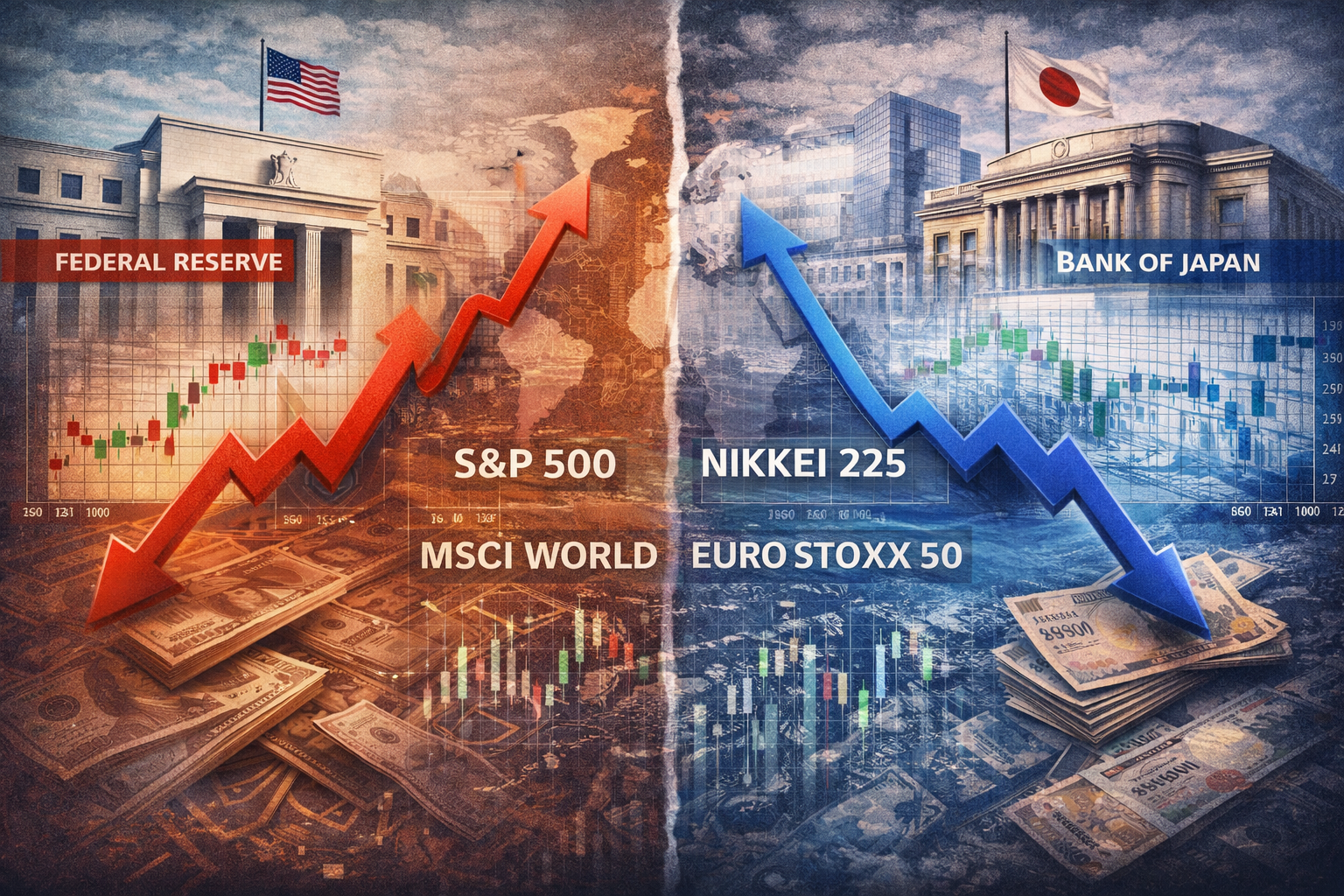
Global equity indices are increasingly being shaped by diverging monetary policy paths between major central banks, with the contrast between the Federal Reserve and the Bank of Japan emerging as a key driver of market volatility. As investors adjust to differing policy trajectories, shifts in liquidity and currency dynamics are feeding directly into index level performance.
The Federal Reserve continues to maintain a relatively restrictive policy stance as it navigates persistent inflation pressures and resilient economic conditions. Market participants are closely monitoring signals around the timing of potential rate adjustments, but expectations have shifted toward a more cautious approach. This has kept financial conditions tighter, influencing valuations across equity markets and limiting the upside for rate sensitive sectors.
In contrast, the Bank of Japan remains more accommodative, even as it gradually adjusts elements of its long standing policy framework. While there have been incremental changes, overall conditions in Japan are still characterized by relatively low borrowing costs and supportive monetary settings. This divergence has led to notable currency movements, particularly a weaker yen against the US dollar, which is playing a significant role in shaping equity flows.
A weaker yen tends to support Japanese export oriented companies, boosting corporate earnings expectations and lifting domestic equity indices. As a result, Japanese markets have shown periods of strength, benefiting from both currency dynamics and continued policy support. At the same time, this creates competitive pressures for companies in other regions, adding complexity to global index performance.
For US and European indices, tighter monetary conditions are weighing on broader market participation. While certain sectors such as technology continue to provide support, many industries are facing headwinds linked to higher financing costs and slowing demand. This divergence within indices is contributing to increased volatility, as gains in a few large companies offset weakness elsewhere.
The interaction between these policy paths is also influencing global capital flows. Investors are reallocating funds in response to relative yield differences and currency expectations, which in turn impacts equity markets across regions. These shifts can amplify market movements, particularly during periods of heightened uncertainty.
Looking ahead, global equity indices are likely to remain sensitive to further developments in central bank policy. Any changes in the stance of the Federal Reserve or the Bank of Japan could quickly alter market dynamics. As divergence persists, volatility is expected to remain elevated, with investors continuing to navigate a complex environment shaped by policy contrast and shifting economic conditions.
Terms in this article
Federal Reserve (Fed)
The US central bank, with a dual mandate of maximum employment and stable prices.
Volatility
The size and speed of price changes, commonly measured as the annualised standard deviation of returns.
Central bank
The institution that sets a country's or region's monetary policy, issues its currency and oversees the banking system — for example the Federal Reserve, European Central Bank, Bank of England and Bank of Japan.
Liquidity
How easily an asset can be bought or sold in size without moving its price much.
Inflation
The rate at which the general level of prices rises over time, reducing what money can buy.
Ask about this story
Questions are answered only from this article and the sources it cites.
MarketAlleys provides news and analysis for information only; it is not investment advice or a recommendation to buy or sell any security. Markets involve risk. Risk disclaimer.
Was this useful?
Report an issue with this article
Get the Daily Brief
What moved, why, and what matters next — every morning.
Related coverage
CNBC flags six market themes as earnings season and inflation reports approach
CNBC reported Oct 11 that earnings season ramps up this week with four Club holdings set to report and two main inflation reports also out.
MarketAlleys Research Desk · · 3 min read
Closing Tape, Friday October 9, 2026: US ETFs finish higher
US ETFs rose from the prior close while gold and silver advanced; Amazon led gainers and Apple lagged. Treasury yields were lower as of Thu Oct 8; Bitcoin rose over 24 hours.
MarketAlleys Research Desk · · 5 min read
US Premarket Brief, Friday October 9, 2026: mixed global moves, Bitcoin up 0.84%
Global ETFs were mixed—SPY ETF fell 0.42% from the prior close and QQQ ETF fell 1.34%—while Bitcoin rose 0.84% over 24 hours and the USO ETF rose 2.55% from the prior close.
MarketAlleys Research Desk · · 5 min read
Closing Tape, Thursday October 8, 2026: SPY ETF fell 0.42% from the prior close
US ETFs were mixed as markets closed: the SPY ETF fell 0.42% and the QQQ ETF fell 1.34%, while the DIA ETF rose 0.12% on Oct 8, 2026.
MarketAlleys Research Desk · · 5 min read