Gold Prices Surge to Record Highs Amid Dollar Decline and Trump’s Fed Overhaul Plans
Gold prices have soared to record-breaking levels as investor anxiety intensifies over the weakening U.S. dollar and former President Donald Trump’s proposed restructuring of the Federal Reserve.
MarketAlleys Desk
Published · 2 min read
Introduction
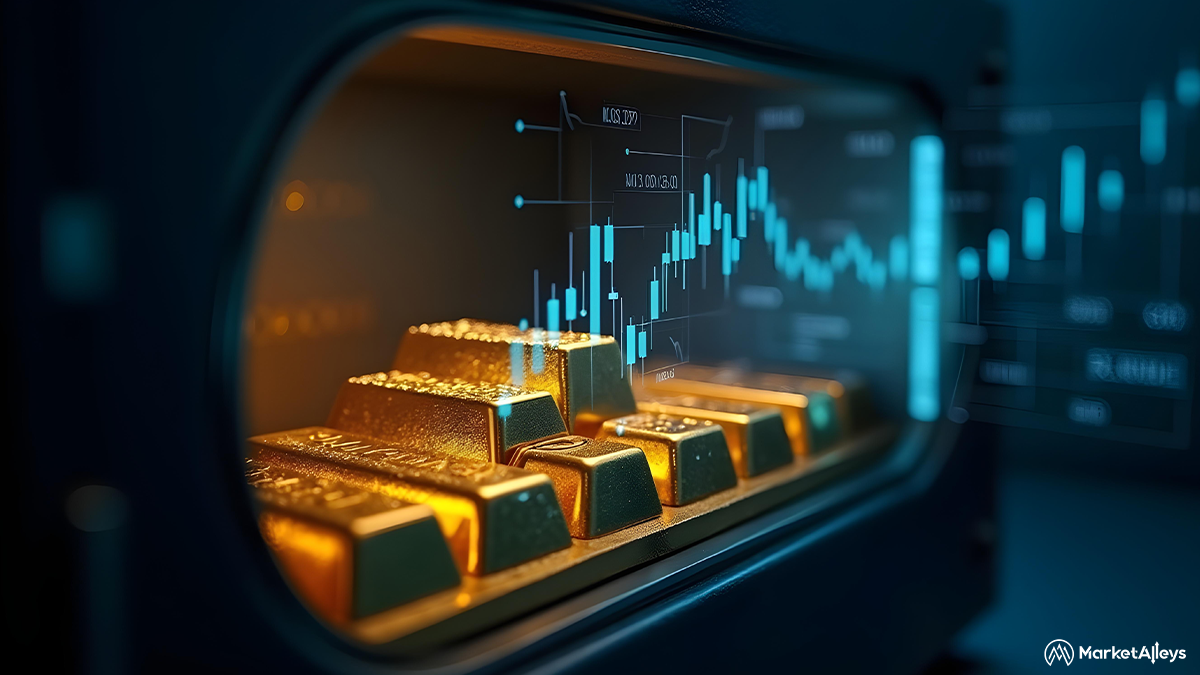
Gold prices have soared to record-breaking levels as investor anxiety intensifies over the weakening U.S. dollar and former President Donald Trump’s proposed restructuring of the Federal Reserve. The dual pressure of market uncertainty and the looming possibility of a shift in U.S. monetary policy has pushed investors toward the traditional safe-haven asset, fueling a significant rally in gold markets globally.
Key Takeaways
• Gold reaches record highs as investors seek safety amid the dollar’s decline.
• Trump’s proposed Fed changes heighten concerns about economic stability.
• Inflation and market volatility continue to drive the demand for precious metals.
• The U.S. Federal Reserve’s influence on financial markets is under scrutiny.
Gold’s Market Surge Amid Dollar’s Fall
In recent days, gold prices have spiked dramatically, setting new all-time highs as global traders respond to rising economic and political uncertainties. A key driver of this rally is the weakening U.S. dollar, which typically boosts demand for gold priced in dollars. As confidence in the greenback slips, gold becomes more attractive to investors seeking to preserve value. The uncertainty surrounding Trump’s suggested overhaul of the Federal Reserve has added fuel to this rally, amplifying the perceived risk in traditional financial markets. The more fragile the outlook becomes, the stronger gold shines as a hedge against volatility.
The Impact of Trump’s Fed Overhaul Proposal
Trump’s proposal to overhaul the Federal Reserve has introduced new waves of uncertainty to the already fragile market environment. Critics argue that the plan threatens the independence of the central bank and could undermine investor confidence in the U.S. economy. With the potential for sweeping changes in monetary policy, concerns have mounted over future inflation, interest rates, and market regulation. The prospect of politicizing the Fed has made global investors wary, triggering a move into assets considered more stable — with gold leading the pack. This shift reflects not only a reaction to policy uncertainty but also growing distrust in long-term financial governance.
Inflation and Commodities in Focus
Persistent inflation has remained a pressing concern in global markets. Despite efforts by central banks to contain it, price pressures on consumers and industries continue to mount. This macroeconomic backdrop has strengthened the appeal of tangible assets like gold. As inflation erodes the value of fiat currencies, investors increasingly turn to commodities that historically maintain purchasing power. The weakening dollar only accelerates this trend, making gold even more desirable across international markets. In this climate, commodities serve as both a shield and a signal — a shield against volatility and a signal of deeper economic shifts taking place beneath the surface.
Conclusion
The rapid rise in gold prices marks more than just a spike in commodity trading — it is a clear reflection of the uncertainty gripping global markets. With the U.S. dollar weakening and Trump’s proposed changes to the Federal Reserve shaking investor confidence, gold has reasserted its place as a key safe-haven asset. As inflation, policy instability, and currency concerns persist, the spotlight will remain firmly on gold. Whether as a hedge, an investment, or a warning sign, gold’s new highs tell a story of a world navigating complex economic tides with caution and calculation.
Terms in this article
Gold (XAU)
A precious metal held as a store of value, a hedge against currency debasement and a safe haven, as well as used in jewellery and industry.
Price-to-earnings ratio (P/E)
Share price divided by earnings per share.
Federal Reserve (Fed)
The US central bank, with a dual mandate of maximum employment and stable prices.
Safe haven
An asset expected to hold or gain value during market stress.
Inflation
The rate at which the general level of prices rises over time, reducing what money can buy.
Ask about this story
Questions are answered only from this article and the sources it cites.
MarketAlleys provides news and analysis for information only; it is not investment advice or a recommendation to buy or sell any security. Markets involve risk. Risk disclaimer.
Was this useful?
Report an issue with this article
Get the Daily Brief
What moved, why, and what matters next — every morning.
Related coverage
US Premarket Brief, Thursday October 8: Asian and European ETFs fell; bitcoin down 1.28%
Asian and European ETFs were lower on Oct 7; Bitcoin fell 1.28% over 24 hours as of Oct 8, 12:30 UTC. US markets trade today and the Department of Labor's weekly jobless claims is scheduled.
MarketAlleys Research Desk · · 4 min read
Gold Price Action Amid Rising Real Yields and a Renewed Oil Inflation Premium
Gold lost ground as crude rose. That split is the story. A haven bid usually arrives when oil jumps on Middle East risk. This week the opposite trade won.
MarketAlleys Desk · · 2 min read

Gold Price Action After Hawkish US Rate Repricing and a Weaker Safe Haven Bid
Gold has lost some of its recent bid after markets repriced the chance of tighter US policy. The metal had been supported by fiscal worry, geopolitical tension, and a search for assets that do not depend on a single central bank.
MarketAlleys Desk · · 2 min read

Gold Market Response to Expanded US Treasury Long End Buyback Operations
The gold market has reacted to the recent decision by the United States Treasury to expand its program of long end bond buybacks.
MarketAlleys Desk · · 2 min read